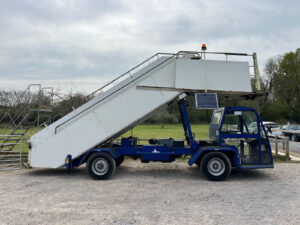
Self-propelled passenger stairs are an essential piece of ground support equipment used at airports worldwide to facilitate the safe boarding and deplaning of passengers when an aircraft is parked on a remote stand without access to a jet bridge or fixed airstair system. These mobile units provide a direct connection between the aircraft door and the apron surface, allowing passengers to embark and disembark efficiently even in locations where terminal infrastructure is limited or gate availability is constrained.
Unlike towable stair units, self-propelled stairs are equipped with their own drive system, enabling operators to position them quickly and accurately alongside the aircraft. This mobility is especially valuable during busy turnaround operations, where speed and precision are critical. The stairs can be adjusted in height to suit different aircraft types, from smaller regional jets to larger narrow-body and wide-body airliners, ensuring compatibility across a wide range of fleets.
Passenger safety is a key focus in the design of self-propelled stairs. Features such as non-slip steps, sturdy handrails, enclosed side panels, and controlled approach systems help reduce risks during boarding and deplaning. Many modern units also include weather protection canopies, integrated lighting, and advanced braking and stabilisation systems to ensure safe operation in varying airport conditions.
Self-propelled stairs play a vital role in supporting flexible airport operations, particularly at airports with high traffic volumes, low-cost carrier terminals, or remote parking stands. By enabling passenger access without permanent boarding bridges, they provide airports with a cost-effective and adaptable solution that keeps aircraft movements flowing smoothly and passengers moving safely between terminal and aircraft.