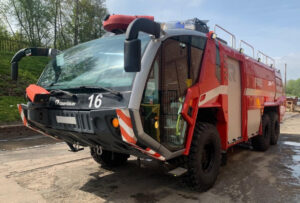
Essential Fire Protection for Modern Airports
Airport Ground Equipment (AGE) plays a critical role in maintaining the safety, efficiency, and reliability of airport operations worldwide. Among the most vital categories of ground support equipment are Airport Rescue and Fire Fighting Vehicles (ARFF), which are specifically engineered to respond rapidly and effectively to aircraft incidents, emergencies, and fire hazards on and around the airfield.
ARFF vehicles form the backbone of an airport’s emergency response capability, ensuring compliance with international aviation safety standards while protecting passengers, crew, aircraft, and infrastructure.
Airport Rescue and Fire Fighting Vehicles (ARFF): Purpose and Design
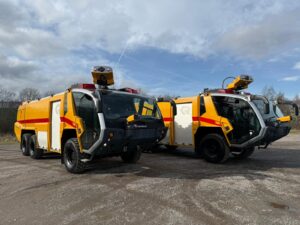
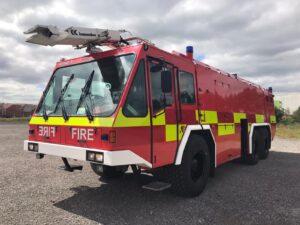
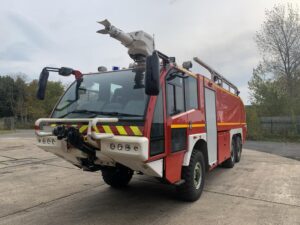
Airport Rescue and Fire Fighting Vehicles are purpose-built emergency response vehicles developed exclusively for aviation incidents. Unlike municipal fire engines, ARFF vehicles are designed to operate at high speeds across runways and taxiways, reach incidents within strict response times, and suppress aircraft fires involving fuel, composite materials, and high temperatures.
Key design characteristics of ARFF vehicles include:
High-capacity water, foam, and dry chemical systems
Roof and bumper-mounted monitors for rapid fire knockdown
All-wheel drive and off-road capability
Reinforced cabs with crew protection systems
Advanced visibility and thermal imaging technology
Manufacturers of ARFF appliances include:
- SIDES
- Rosenbauer
- Oshkosh
- Kronenburg
- Scania
- M.A.N
- Mercedes
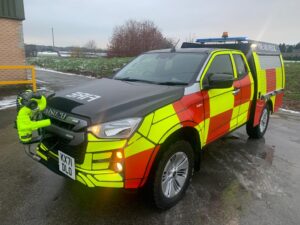
We can also supply smaller Rapid Intervention Vehicles (RIV’s) based on Isuzu and Toyota 4×4 chassis (see www.trfv.uk) as well as domestic type fire appliances.
Why Fire Fighting Vehicles (ARFF) Are Critical to Airport Safety
International aviation authorities such as ICAO, EASA, and the FAA require airports to maintain certified ARFF capabilities based on aircraft size and traffic volume. These regulations ensure that in the event of an emergency, ARFF crews can respond within minutes and control fires quickly enough to support passenger evacuation.
ARFF vehicles are used for:
Aircraft accident and incident response
Fuel spill and fire suppression
Cabin and cargo fire intervention
Emergency standby during take-off and landing
Structural and airside fire incidents
Their presence is not only a regulatory requirement but a fundamental component of airport risk management.
Types of Fire Fighting Vehicles (ARFF) Used in Airport Operations
Modern airports deploy a range of ARFF vehicles to match operational needs and aircraft categories:
Rapid Intervention Vehicles (RIV)
Compact and highly manoeuvrable, RIVs are designed for fast initial response and early fire suppression.
Major Foam Tenders
Large ARFF vehicles carrying significant volumes of water and firefighting foam, capable of handling wide-body aircraft incidents.
Command and Support Vehicles
Used for incident coordination, communications, and logistical support during extended emergency operations.
Each vehicle type contributes to a layered and resilient emergency response strategy.
Advanced Technology in Modern Fire Fighting Vehicles (ARFF)
Today’s Airport Rescue and Fire Fighting Vehicles incorporate cutting-edge technology to improve effectiveness and crew safety. Features often include:
Electronically controlled firefighting systems
Infrared and thermal imaging cameras
Advanced suspension for high-speed response
Environmentally compliant foam systems
Ergonomic cab layouts to reduce crew fatigue
These innovations help airports meet increasingly strict safety and environmental standards while maintaining rapid response capabilities.
Fire Fighting Vehicles (ARFF) as a Core Element of Airport Ground Equipment
Within the broader category of Airport Ground Equipment, ARFF vehicles stand apart due to their life-critical function. They are not simply support vehicles but emergency assets that protect lives, aircraft, and airport operations.
Airports investing in modern, well-maintained ARFF fleets benefit from:
Improved regulatory compliance
Enhanced passenger confidence
Reduced operational risk
Faster recovery from incidents
Conclusion: The Importance of Fire Fighting Vehicles (ARFF) in Airport Ground Operations
Airport Rescue and Fire Fighting Vehicles are an indispensable part of Airport Ground Equipment, providing essential protection across the airfield environment. Their specialised design, advanced technology, and rapid response capability make them a cornerstone of aviation safety.
As airports continue to evolve and aircraft technology advances, ARFF vehicles will remain at the forefront of emergency preparedness, ensuring that safety standards are met and lives are protected at every stage of airport operations.